Background Noise, Foreground Business: Why Streamers Are Now Programming for People Who Aren't Really Watching
Photo: Naula Ayisabun Aningore, CC BY-SA 4.0, via Wikimedia Commons
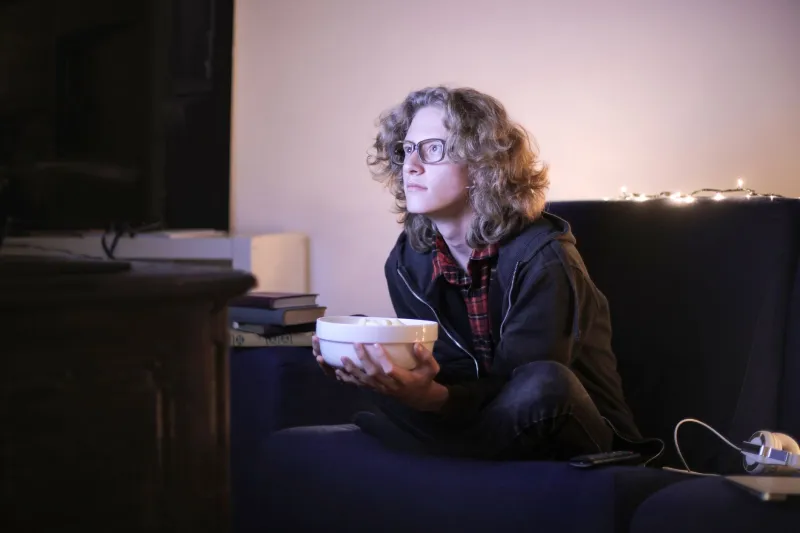
Walk into a random American living room on a Wednesday evening in 2026 and there's a decent chance the TV is on and nobody is looking at it.
Maybe it's a camera on a Norwegian train rolling through the mountains. Maybe it's a fireplace, or a rainstorm on a cabin window, or a four-hour loop of slow television. Maybe it's the eighth consecutive episode of a sitcom everyone in the house has already seen twice — the one that functions less like a story and more like a light source.
This is ambient TV, and it has quietly become one of the more interesting business stories in streaming.
The TV became a fireplace again
There's nothing new about the underlying behavior. People have left TVs on for company since the days of the all-news channel and the weather radar loop. What's new is that the behavior has been productized. Free ad-supported channels — the Pluto TV, Tubi, Roku Channel, Samsung TV Plus tier of the world — have built enormous lineups around content that doesn't demand your eyes. Nature loops. Ambient music channels. Endless marathons of procedural dramas where the plot is optional because you've absorbed it by osmosis.
And the paid streamers are paying attention. Several have experimented with dedicated ambient collections and calm-content shelves, because a subscriber who leaves a fireplace loop running for three hours is, on paper, a very engaged subscriber.
Watch time is a blunt instrument
Here's the tension at the heart of all this. The industry's core metric — hours watched — cannot tell the difference between a viewer glued to a prestige finale and a viewer who wandered off to fold laundry while a coral reef drifted by. Both count.
That's not a bug in the streamers' eyes. Ad-supported platforms sell impressions, and an ambient channel delivers impressions steadily, cheaply, and without the risk of anyone getting bored and leaving mid-episode. The content doesn't need to be good in the way a drama needs to be good. It needs to be pleasant, non-jarring, and endless. That's a fundamentally different production brief, and it's a lot cheaper to fulfill.
The comfort-show industrial complex
Then there's the half-watched sitcom, which might be the most American art form of the decade. Reruns of The Office, Friends, Parks and Recreation, and their descendants have become the streaming equivalent of a favorite sweatshirt — shows you put on not to find out what happens but to feel like the room has company in it.
This isn't laziness. For a lot of people it's the only kind of TV that fits. Someone working a night shift, someone studying, someone home alone with a laptop and a low-grade need for human voices — ambient programming meets them where they actually are, which is not on the edge of their seat.
What it costs the stuff you care about
So is this bad news for people who actually watch television? Not automatically, but the incentives are worth watching closely.
If a platform can hit its engagement targets with cheap looping content, the pressure to fund ambitious, attention-demanding drama doesn't disappear — but it does get a little less urgent. The shows that require your full focus have to justify themselves against a background-noise catalog that costs a fraction as much and generates hours just as easily. That's a real trade-off, even if nobody puts it in a press release.
The counterargument is that ambient content is additive. It fills the hours nobody was going to spend on a six-part limited series anyway — the 2 p.m. work-from-home block, the 1 a.m. wind-down, the Sunday afternoon when the football's over and the house is quiet. In that reading, ambient TV isn't competing with prestige TV. It's competing with silence, and with the radio, and with a phone propped against a coffee mug.
The always-on living room
Either way, the direction is clear. The living room screen is drifting back toward what it was before streaming trained us all to watch on purpose: a thing that's simply on. A source of light, sound, and mild company for a country that spends a lot of time in rooms by itself.
The streamers have noticed. The next few years of programming decisions will tell us exactly how much they think that's worth — and how much room is left over for the shows that want your whole brain.